Rural marketing M.com semester – iii (cbcs) most important questions
  M.COM SEMESTER – III (CBCS) RURAL MARKETING  Most Important Question Bank for Current Exam   Module – I Q.2. Explain the evolution of Rural Marketing. ANS: Part I (Before 1960): Rural marketing referred to selling of rural products in rural and urban areas and agricultural inputs in rural markets. It was treated as synonymous to … Read more
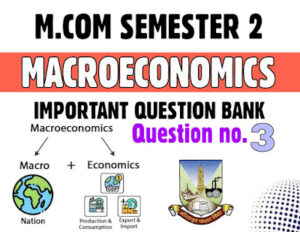
M.com 2nd sem Economics importance question papers with answers mumbai university

  M.Com SEMESTER – II MACROECONOMIC   1.   Q.3. Explain the concept of National Income Deflator. ANS: When we divide nominal national income by real national income, we obtain the national income deflator. The real national income can be calculated by dividing nominal national income by the national income deflator. The national income deflator for various … Read more

Explain in detail the social objectives of the business fybcom sem 1

 F.Y.B.COM ( SEMESTER – I ) Commerce Paper I (Introduction to Business) Q3. Explain in detail the Social objectives of the Business. Social Objectives Business : Business is a part of a social System. A social system involves people and their Organisations in mutual relationship to each other. Business is an integral part of society. … Read more

Explain the Meaning and scope of Business F.Y.B.COM SEM I Commerce Paper I

  F.Y.B.COM ( SEMESTER – I ) Commerce Paper I (Introduction to Business)     Q1. Explain the Meaning and scope of Business. Meaning :- According to L.H. Haney, “Business is a human activity directed towards producing or acquiring wealth through buying and selling activities.” SCOPE OF BUSINESS Business has a very wide scope. It … Read more

S.Y.B.com sem 3 management accounting mcq pdf

Management Accounting MCQ Semester 3   1)    Working capital is an excess of current assets over current _____. a)    Liabilities b)    Operating Ratio c)    No of times d)    Fixed Assets ANS: A   2)    ______ shows the period for which amount of sales remains invested in debtors. a)    Liquid Assets b)    Collection c)    Period Long … Read more